
At Freshlab we spend our days installing local artificial intelligence infrastructure for companies. Private servers, models that never leave the office, GDPR compliance. Very technical work. And yet the question we hear most often is not technical, it is domestic: "so what do I do about my kids and AI?".
That question deserves a serious answer, because there is a legitimate worry behind it. Children no longer discover artificial intelligence in a technology class. They discover it on their phone, by consuming it: a chatbot that does their homework, a filter that generates images, an endless video recommended by an algorithm. Consuming AI is easy and addictive. Creating with it is something else.
The difference between consuming and creating
Consuming artificial intelligence means accepting whatever the machine hands you. Creating with it means deciding for yourself what you want to do and using the tool to get there. The distance between those two stances is enormous, and it decides who is in charge: the person or the system.
A teenager who asks a model to summarize a book is consuming. The same teenager who uses that model to prototype an app, compose a song, or build an argument and then defend it, is creating. The tool is identical. The attitude is not.
This idea, create instead of consume, is exactly what we apply with our business clients. A company that only consumes cloud AI depends on third parties and gives away its data. A company that creates with its own local AI, under its own control, gains sovereignty. At home the logic is the same, only the scale changes.
Three books for three ages
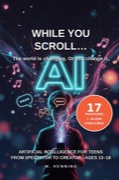
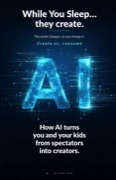
That is why we publish While You Create, a series of three books that teach how to create with artificial intelligence according to the reader's age. They are not technical manuals or catalogues of apps that will be obsolete in six months. They are books about the right attitude toward a technology that is not going away.
- The book for children, ages 8 to 12, introduces the idea with examples and simple challenges.
- The book for teenagers, ages 13 to 18, moves into more ambitious projects and into critical thinking about what AI generates.
- The book for adults and families helps you accompany rather than police, and lets parents understand the same thing as their children.
All three share one conviction: the best protection is not to ban AI, but to teach how to use it from the side of the person who creates.
For the classroom too
School has an obvious role in all of this, so we opened a free area for the classroom with the published methodology, sessions organized by age, and printable sheets for families. Any teacher can use it. It is available in Spanish, German, English, French, and Italian, because the conversation about growing up with AI has no borders.
Why a local AI company does this
It may seem odd that a company selling AI infrastructure to businesses spends time on children's books. To us it is consistent. We work every day with the risks of delegating intelligence to systems you do not control, and we see what changes when an organization takes that control back. We want the next generation to reach that conclusion sooner, and not after they have already given away their attention and their data.
Create, don't consume. With local AI in the company, and with a book on the kitchen table. You can start at whileyoucreate.com, or with our overview page of the series, with all three books and the most common questions.